
Industrial Chic to Rural Rugged: The Versatility of Corrugated Siding in AK Design
May 8, 2026 3:06 pm Leave your thoughtsCorrugated metal siding has come a long way from its utilitarian roots on barns and warehouses. Across Alaska, architects, builders, and homeowners are embracing this dynamic material in ways that blend raw industrial character with refined modern aesthetics. Whether you are designing a sleek urban loft in Anchorage or a rugged off-grid retreat deep in the interior, corrugated metal siding trends in 2026 are proving that this material belongs in nearly every design conversation happening across the Last Frontier.
Why Corrugated Metal Siding Is Having a Major Moment in 2026
The resurgence of corrugated siding is not accidental. It reflects a broader cultural shift toward honest materials, those that show their origins, age gracefully, and perform without pretense. In 2026, modern steel home design has moved firmly into the mainstream, driven by a generation of homeowners who value durability over decoration and authenticity over artifice.
Alaska presents a uniquely demanding environment for any building material. Extreme cold, heavy snowfall, high winds, seismic activity, and prolonged exposure to moisture all conspire to break down conventional siding options faster than manufacturers would prefer. Corrugated metal siding, by contrast, thrives under pressure. Its ribbed profile adds structural rigidity, allowing panels to resist bending and buckling under heavy snow loads. Its factory-applied coatings resist corrosion even in coastal zones where salt air is a constant threat.
Beyond performance, the aesthetic appeal of corrugated metal is undeniable. The interplay of light and shadow created by the ridged surface gives buildings a sense of depth and texture that flat materials simply cannot replicate. As decorative metal panels have grown more sophisticated, designers are finding ways to use corrugated siding not just as a protective shell, but as a primary design statement.
From Anchorage to the Bush: How Alaska’s Regions Are Embracing the Trend
The corrugated metal siding trends of 2026 are not monolithic. They look different depending on where you are in Alaska, and that regional variation is part of what makes the material so compelling.
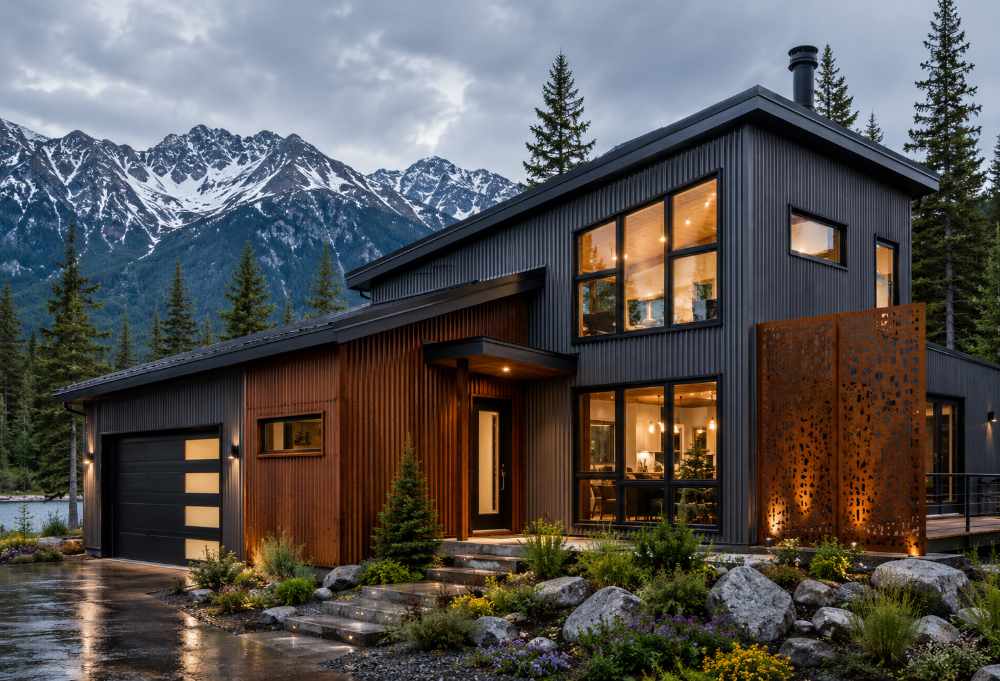
In Anchorage, the state’s largest city, modern steel home design is influencing residential neighborhoods that have historically favored vinyl and fiber cement. Homeowners are pairing dark corrugated steel panels with large expanses of triple-pane glazing, creating facades that feel simultaneously industrial and inviting. The contrast between the raw, matte texture of the metal and the warmth of interior lighting visible through oversized windows has become something of a signature look for the Anchorage design scene in 2026.
Further north, in communities like Fairbanks and Nome, the aesthetic priorities shift. Here, practicality drives nearly every decision. Corrugated metal siding has long been common on commercial and industrial structures in these regions, but it is increasingly appearing on residential builds as well. Homeowners appreciate its resistance to the punishing freeze-thaw cycles that destroy less resilient materials. The color palette in these communities tends toward earth tones and muted grays, blending new construction into landscapes defined by boreal forest and tundra.
In Southeast Alaska, where communities like Juneau, Sitka, and Ketchikan receive some of the highest annual rainfall totals in North America, corrugated metal siding offers critical protection against moisture infiltration. The standing ridges channel water away from the building envelope efficiently, reducing the risk of water intrusion that plagues wood-based siding systems in these perpetually wet climates. Architects working in this region are pairing corrugated panels with generous roof overhangs and strategic material layering to create homes that handle rainfall as gracefully as they handle a sunny summer afternoon.
Across rural Alaska, corrugated metal siding fits naturally into a broader tradition of resourceful building. Remote communities often depend on materials that can be transported, stored, and installed with minimal equipment and specialized labor. Corrugated panels are lightweight relative to their strength, can be cut with basic tools, and require no painting or staining once installed. This practicality keeps them in steady demand across the bush, where logistics and cost drive material selection more than any design trend.
Decorative Metal Panels: Elevating the Industrial Aesthetic
One of the most exciting developments in corrugated metal siding trends for 2026 is the evolution of decorative metal panels into genuine design elements rather than afterthoughts. Manufacturers are now offering corrugated and ribbed panels in an expanded range of profiles, finishes, and colors that allow designers to express nuanced aesthetic visions without sacrificing any of the material’s practical advantages.
Weathering steel, which develops a stable rust patina over time, has become popular on both commercial and residential projects across Alaska. Its warm amber and sienna tones provide a striking visual counterpoint to the grey skies and evergreen landscapes that define much of the state. When used as decorative metal panels on accent walls or entry features, weathering steel creates a connection between the built environment and the natural landscape that feels organic rather than forced.
Perforated corrugated panels are another growing trend. By introducing patterns of holes or cutouts into the standard ribbed profile, designers can control light transmission, create privacy screens, and add visual complexity to otherwise straightforward facades. In commercial applications around Anchorage, perforated panels are being used to wrap parking structures and retail facades with a layer of visual interest that softens the utilitarian nature of the underlying structure.
Color is also playing a larger role in modern steel home design in 2026. While black, charcoal, and deep navy remain perennial favorites for their ability to frame views and recede visually into forested settings, bolder choices are emerging. Forest green, burnt orange, and even muted terracotta are appearing on residential projects across the state, reflecting a growing confidence among Alaskan homeowners to use their homes as expressions of personal identity rather than simply as shelters from the elements.
Practical Considerations for Alaskan Installations
Choosing corrugated metal siding for an Alaskan project requires careful attention to a few installation and performance factors that are less critical in milder climates.
Thermal bridging is a primary concern. Metal conducts heat rapidly, which means that improperly detailed installations can create pathways for heat loss through the building envelope. In Alaska’s extreme cold, this is not a minor issue. Builders are addressing this challenge by incorporating continuous insulation layers between the structural wall and the metal cladding, breaking the conductive pathway and maintaining the thermal performance of the overall assembly.
Fastener selection matters enormously in freeze-thaw environments. Corrugated metal panels expand and contract with temperature changes, and fasteners that cannot accommodate this movement will eventually work loose or cause the panel to crack around the fastener hole. Experienced Alaskan installers use fastener systems designed for high thermal movement, along with neoprene washers that maintain a weathertight seal through repeated cycles of expansion and contraction.
Ventilation behind the panels is another best practice that is gaining wider adoption. A vented rainscreen gap between the back of the metal panel and the water-resistant barrier beneath allows any moisture that penetrates the system to drain and evaporate rather than accumulate. In Alaska’s high-moisture coastal zones, this detail can mean the difference between a cladding system that performs for decades and one that fails prematurely.
Conclusion
Corrugated metal siding is no longer a material reserved for agricultural sheds and industrial warehouses. Across Alaska, from the urban neighborhoods of Anchorage to the remote communities of the bush, this versatile material is redefining what modern steel home design can look like in one of the world’s most demanding environments. The decorative metal panels, bold color palettes, and thoughtful detailing that characterize corrugated metal siding trends in 2026 reflect a design culture that values both beauty and resilience. For Alaskan homeowners and builders willing to embrace its industrial character, corrugated siding offers a rare combination of authentic aesthetic appeal and proven real-world performance.
Got questions? Let us help! Call us today to learn more!
Categorised in: Commercial Metal Siding
This post was written by admin